
Menu software comparisons
aiMenuu vs GloriaFood: Menu Publishing or Online Ordering?
Compare aiMenuu and GloriaFood by menu setup, QR experience, ordering scope, maintenance, transition risk and restaurant fit.
aiMenuu Editorial Team · November 16, 2026 · 10 min read

aiMenuu and GloriaFood both put restaurant information on a guest’s phone, but they are built for different jobs. The AI menu maker workflow in aiMenuu turns an existing PDF or menu photo into an editable mobile-menu draft, lets staff review it, and publishes it behind a lasting QR code. GloriaFood is an online-ordering system that combines a menu with order taking, fulfilment settings, reservations, promotions and related restaurant operations. GloriaFood and Oracle list different dates for the shutdown. If you rely on GloriaFood, plan to switch before March 31, 2027, the earlier date, and check the notice in your account.
Quick answer: different operating jobs
Choose aiMenuu when the immediate requirement is a clear phone-friendly menu built from approved source material and updated without replacing the table QR code. It does not process orders, delivery, reservations or point-of-sale transactions. That narrower boundary can make ownership and quality checks easier for a restaurant that already has its transaction systems.
Choose GloriaFood only as part of a time-bounded operating decision. Its current official pages describe website and mobile ordering, dine-in QR ordering, scheduled orders, promotions, reservations, reporting and optional paid services. Those capabilities go beyond menu publishing, but the announced end date means an existing user also needs an export, replacement and cutover plan.
Do not compare the products by counting features. Write the guest journey first: browse only, browse and order, pay online, reserve, or coordinate delivery. Then test the smallest workflow that completes that journey safely.
Set the scope boundary before comparing
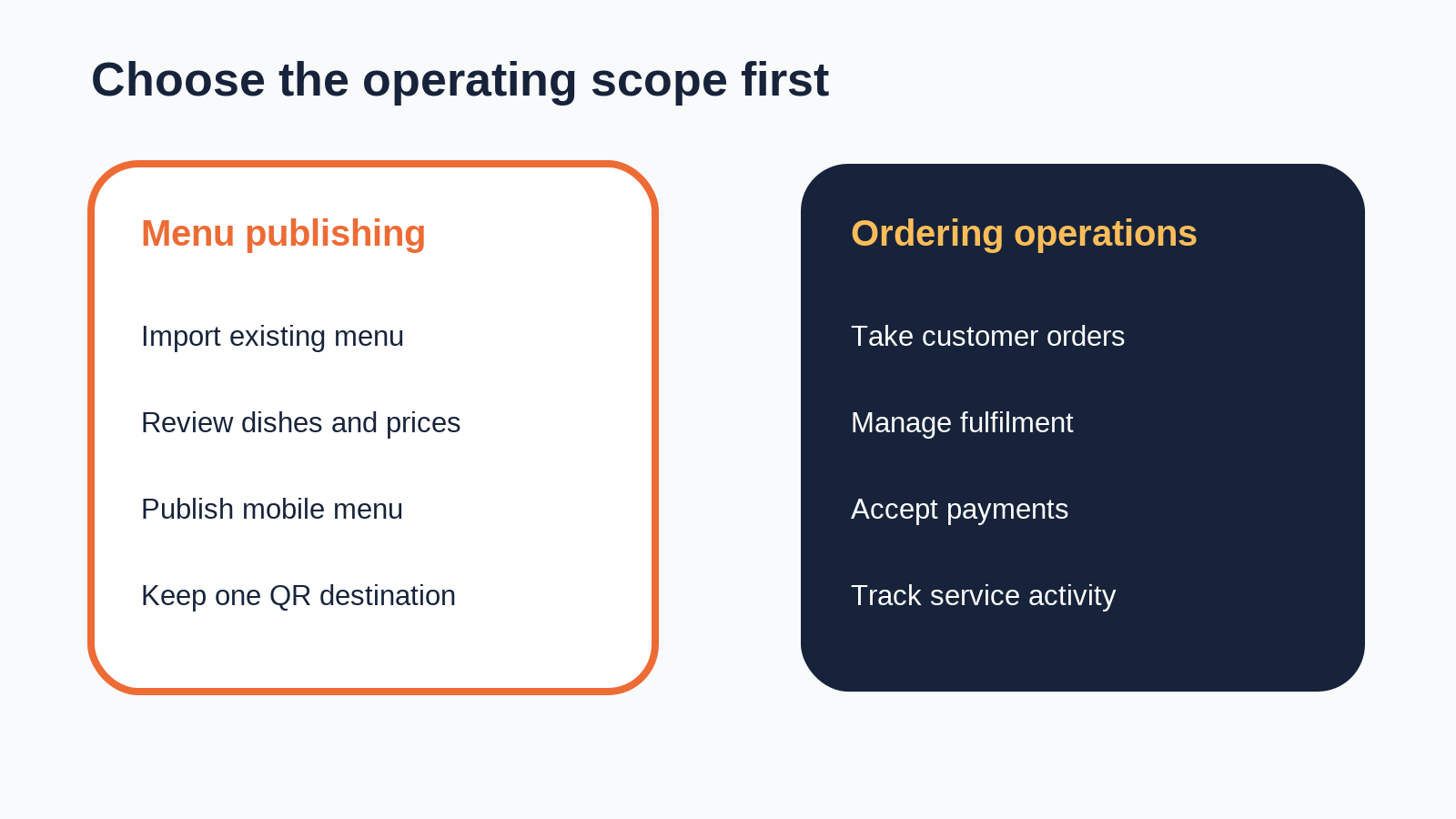
A digital menu can be a publishing surface or the front end of a transaction system. Publishing requires accurate content, readable presentation, a stable URL and controlled updates. Ordering adds modifiers, taxes, service areas, timing, payment, confirmation, cancellation, kitchen handling and customer support.
aiMenuu concentrates on publishing. Its current terms describe importing an existing menu, reviewing AI-assisted extraction, editing structured content, choosing a mobile design, publishing a phone-friendly menu and generating a QR code. The terms explicitly say it is not a print-menu, ordering, delivery, reservation or POS service.
GloriaFood’s product pages describe the transaction group as well as the menu. Restaurants can configure pickup or delivery, scheduled orders, out-of-stock states, promotions, table reservations and integrations. If those functions matter, evaluate the complete order path rather than judging only the menu screen.
Build both tests from one approved source
Export one current menu controlled by the restaurant. Mark its effective date, currency, tax treatment, service periods and approver. Include a long dish name, options, a temporarily unavailable item, an allergen statement and at least one image so the test contains real edge cases.
In aiMenuu, upload the PDF or menu photographs and review the extracted categories, names, descriptions and prices. Count every correction before publication. AI-assisted extraction can accelerate structure, but staff remain responsible for checking the result, especially allergen and dietary information.
In GloriaFood, enter the information needed for the ordering menu, then configure choices, add-ons, availability and fulfilment settings used by the intended service. Time the complete setup, including operational fields that do not exist in a browse-only menu. Extra setup may be justified when it replaces real order work.
Test the guest journey on real phones
Print the test QR code at the size and material planned for service. Scan it at different distances and under actual lighting. Open the result on a small phone, a larger phone and a slower connection. Check text size, category navigation, price visibility, image crops and the route back to restaurant information.
For aiMenuu, ask a guest to find three dishes, compare two prices and identify a dietary note. Update one price and confirm that the same QR destination shows the approved change. This tests the central maintenance workflow rather than a one-time demo.
For GloriaFood, continue through item selection, modifiers, fulfilment choice, contact details, payment where applicable, confirmation and restaurant acceptance. Confirm what happens when an item is unavailable, the restaurant is closed or the order-taking device cannot be reached.
Plan around GloriaFood’s announced end of life
GloriaFood’s official homepage lists April 30, 2027 as the end-of-life date and says it will support existing customers through then. Oracle’s restaurant technology page says full service is scheduled to end on March 31, 2027. The notices do not explain the difference. Plan to complete your cutover before March 31, and check your account notice or ask support to confirm the dates for your services and data exports. GloriaFood’s notice also says Oracle does not offer a direct replacement and points customers to FoodAmigos as an option.
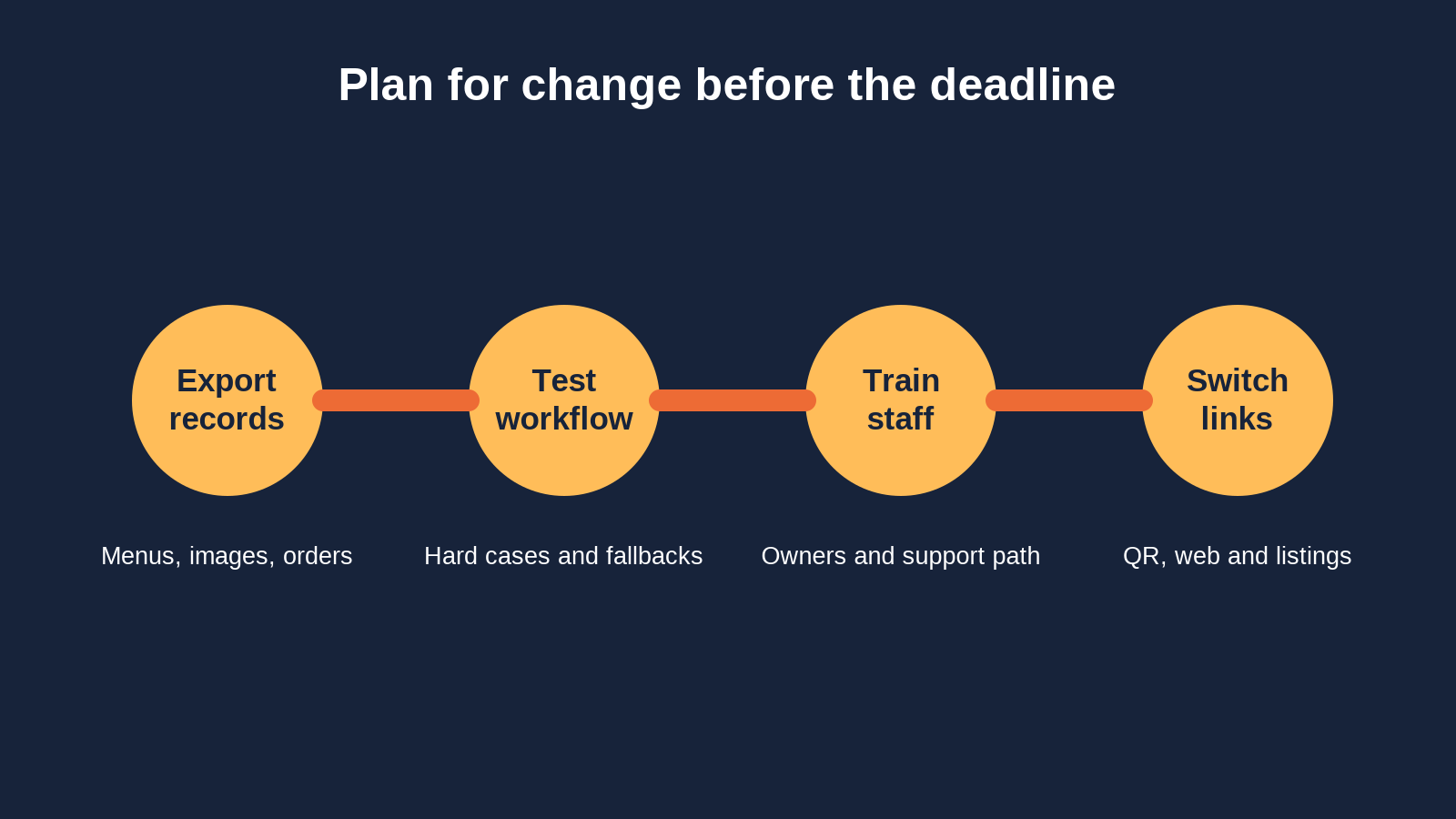
An existing user should inventory menus, modifiers, images, service areas, customer-facing links, integrations, reports and operational records it is entitled to retain. Ask support which data can be exported, in what format and by what deadline. Do not assume a replacement can import every field.
Build the replacement in parallel, test representative orders, train staff and define how scheduled orders and customer questions will be handled around cutover. Update website buttons, social profiles, business listings, table QR codes and printed materials only after the new destination passes acceptance checks.
Compare maintenance and failure handling
Assign an owner for menu content and another for transaction settings when needed. In a focused menu workflow those may be the same person. In ordering, prices, hours, fulfilment rules, integrations and payments can involve operations, finance and support. Document who edits, approves and checks the guest view.
Run a change drill: raise a price, hide an unavailable dish, replace an image and restore the earlier value. Measure elapsed time and number of people involved. Then simulate a failed scan or unavailable order device and confirm the fallback shown to guests.
Keep a dated release note for material menu changes. For ordering, add evidence for taxes, modifiers, hours and acceptance behaviour. For a browse-only menu, retain the approved source and a public check. Good maintenance is repeatable and understandable to the next shift manager.
Calculate cost from useful outcomes
Do not compare a menu publisher and an ordering platform using price alone. Add setup, data cleanup, images, training, integrations, payment services, support, migration and ongoing review. Use an accepted published menu or a successfully completed order as the unit of useful output.
GloriaFood’s pricing page describes a free core service and optional paid services including POS, online payments, reservation deposits and advanced promotions. Verify current availability, country support, commitments and taxes inside the actual account. The end-of-life notice adds transition labour to any 2026 decision.
For aiMenuu, count work from source upload through approved publication and later updates. If the restaurant still needs ordering, price that separate system explicitly. A smaller tool is not cheaper when a required job is unowned; a larger tool is not better when its extra operations are unused.
Run a controlled pilot and decide
Prepare one approved menu and five acceptance tasks. Build the browse experience in both tools. In GloriaFood, also complete a realistic order if transaction capability is required. Record corrections, setup time, guest errors and the steps needed for a routine change.
Score source accuracy, readability, QR stability, update effort, operational scope, training, failure handling, data portability and support. Weight migration risk separately for a service with an announced end date. Save the test date and official pages consulted.
Choose aiMenuu when the restaurant needs a focused route from existing material to a maintained mobile menu. For ordering, select a platform that can support the restaurant beyond the planned period and validate the complete transaction chain before public cutover.
Final recommendation
aiMenuu is the clearer fit for restaurants that already have their ordering process and want a controlled way to convert approved menu material into a readable QR menu. Its limited scope makes the review and ownership model easier to define.
GloriaFood historically covered more of the ordering process, but its discontinuation changes the decision. Existing users should plan migration now and use March 31, 2027 as the safer planning deadline. If you’re choosing an ordering system today, compare providers that can support you beyond the transition.
Whichever route you choose, keep one approved source, test real guest tasks, verify every public change and document the fallback when technology is unavailable.
People also ask
Frequently asked questions
Is aiMenuu an online-ordering or POS system?
No. aiMenuu imports, edits and publishes a mobile restaurant menu with a QR code. It does not process orders, delivery, reservations or POS transactions.
When is GloriaFood scheduled to reach end of life?
GloriaFood’s homepage lists April 30, 2027 as end of life. Oracle lists March 31, 2027 as the end of full service. Plan to switch before March 31 and verify your account’s deadline in its notice or with support.
Can the same QR code stay after a menu update?
aiMenuu is built around a lasting QR destination so approved dish or price changes can be published without replacing the code. Test the live destination after every material update.
Which is better when a restaurant needs online orders?
aiMenuu does not provide online ordering. A restaurant that needs transactions should evaluate an ordering platform and test modifiers, availability, fulfilment, payments, confirmation and support as one workflow.